


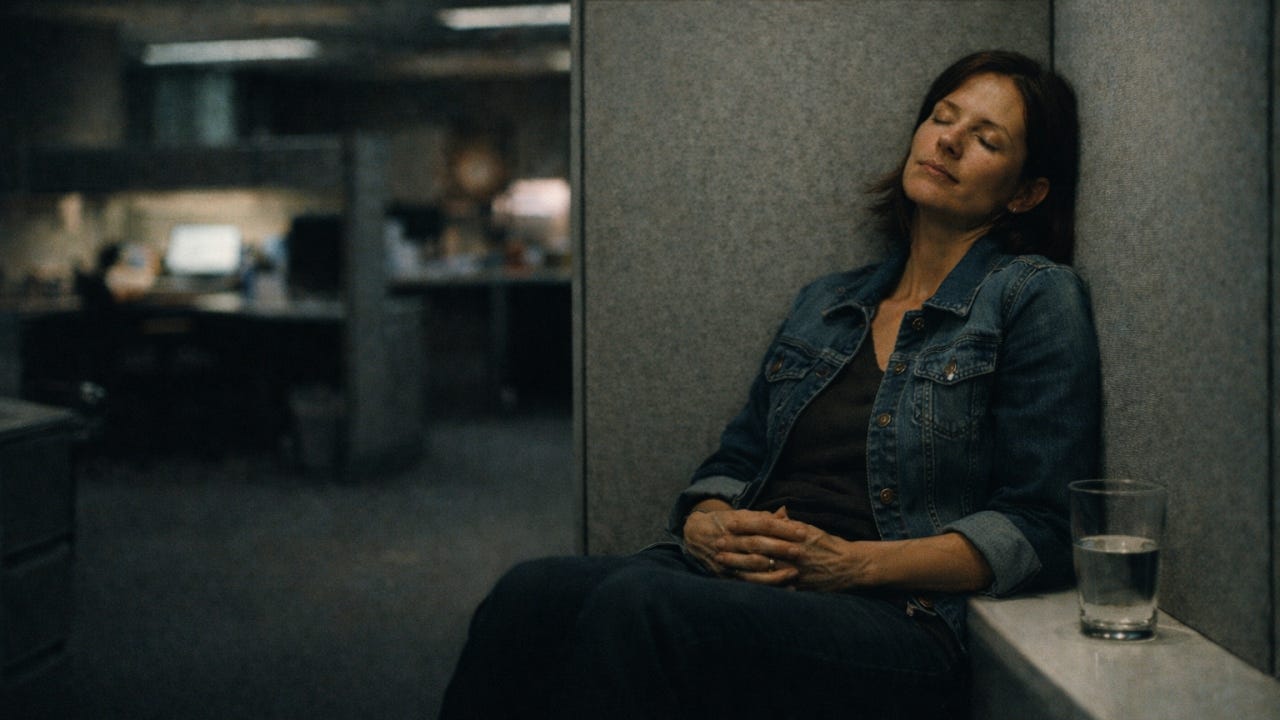
Last time I wrote about the distraction loop - the compulsive phone reach, the checking out behind your own eyes, the nervous system running on empty by 6pm.
I said it wasn’t a discipline problem. It was a safety problem.
A few of you replied. Some of you forwarded it.
One person sent me a message that just said: “Fuck. That’s me.”
So now the obvious question: what do you actually do about it?
And I want to be honest with you here, because this is where most content about nervous system regulation goes wrong.
It either goes full clinical - vagal tone, polyvagal theory, parasympathetic activation - and you nod along and understand it intellectually and nothing changes.
Or it goes full wellness - breathwork retreats, ice baths, guided meditations, morning routines with seventeen steps - and you try it for four days and then your ADHD brain files it under “things I know I should do but don’t.”
Both miss the point.
So I want to talk about what regulation actually looks like in practice. For real people. With demanding jobs and kids and nervous systems that have been running on adrenaline for two decades.
The first thing to understand
Regulation is not calm.
I need to say that again because the entire wellness industry has sold you a lie.
Regulation is not about being calm. It’s not about being zen. It’s not about achieving some blissed-out state where nothing bothers you.
Regulation is the ability to feel what’s actually happening in your body - and stay with it long enough to choose a response instead of being hijacked into a reaction.
That’s it.
You can be regulated and angry. Regulated and scared. Regulated and overwhelmed.
The difference is whether the feeling is running you - or whether you’re in relationship with it.
For most high-performing neurodiverse people, the issue isn’t that they feel too much. It’s that they’ve spent so long overriding what they feel that the body has stopped trusting them to listen. So it escalates.
The signals get louder. The crashes get harder. The distraction loop gets more compulsive.
Not because your system is dysfunctional. Because it’s been ignored.
What doesn’t work (and why)
Before I tell you what does work, let me save you some time.
Morning routines with twelve steps don’t work for ADHD brains.
Sure, they work for about three days, then become another thing you failed at, which feeds the shame cycle, which increases dysregulation.
Congratulations - your wellness practice just made you worse.
Meditation apps don’t work for people whose nervous systems are in chronic hypervigilance. Sitting still with your thoughts when your body is screaming is not regulation. It’s suppression with a calming voice over the top.
“Just be more present” is not a strategy. It’s an instruction that only works if you already have the capacity to do it. Telling a dysregulated person to be present is like telling someone with a broken leg to walk it off.
The reason these don’t work is simple: they all start in the mind.
And the mind is exactly where your nervous system has learned to override the body’s signals.
You can’t think your way into regulation. You have to feel your way there.
What actually works
Here’s what I’ve seen work - consistently - with the kind of people I sit with. Leaders, founders, parents, high-functioning neurodiverse people who’ve been white-knuckling through life.
None of this is exciting. None of it is Instagrammable. All of it is effective.
1. The transition ritual
This is the single most impactful practice I give people. And it’s almost offensively simple.
Before you walk through the front door, before you step from “work mode” into “home mode” - you stop. Wherever you are. Car, hallway, pavement outside your house.
You close your eyes. Three breaths. Deep into the belly. Not the chest - the belly.
And on each exhale, you consciously close a mental door.
The email that didn’t get answered. Close.
The decision that’s still hanging. Close.
The colleague who pissed you off. Close.
Not because those things don’t matter.
But because you’re choosing - physically, with your breath - to stop carrying them across the threshold.
I worked with a father who was drowning in layers of stress. Work, property management, finances, parenting - all stacked on top of each other until there was nothing left.
He couldn’t switch off. Even in the room with his daughter, he was somewhere else.
We didn’t overhaul his life.
We started with this: three breaths before the front door. Closing mental doors one by one. Arriving home in his body, not just his postcode.
It sounds too small to matter.
But when you’ve been in hypervigilance for eight hours straight, the difference between entering your home still wired and entering it having consciously discharged - even for ninety seconds - is the difference between being present with your kid and being a ghost in the kitchen.
He told me later that the hardest part wasn’t the practice itself. It was admitting he needed it.
Because admitting you need ninety seconds to become human again feels like admitting you’ve been failing at something that should come naturally.
It doesn’t come naturally. Not after twenty years of override. It has to be rebuilt. And this is where you start.
2. The body check-in (not the body scan)
I don’t give people thirty-minute body scans. ADHD brains will bail at minute four.
Instead: one question. Multiple times a day.
“Where am I holding right now?”
That’s it. Not a meditation. Not a practice. A question.
Shoulders? Jaw? Lower back? Chest?
You notice it. You breathe into it. You move on.
The point isn’t to fix it.
The point is to rebuild the relationship between your mind and your body.
To start noticing what your body has been trying to tell you while you’ve been overriding it for the last fifteen years.
Most people I work with are shocked when they start doing this.
They’ve been clenching their jaw since 9am and didn’t know it.
Their shoulders have been at their ears through every Zoom call.
Their lower back has been screaming and they’ve been calling it “just a bad chair.”
Your body keeps receipts.
This question teaches you to read them before the bill comes due at 6pm.
3. One joy anchor
This one people resist, because it sounds soft.
I ask: what’s one thing - five minutes, no more - that makes you feel like yourself?
Not productive. Not useful. Not optimising anything. Just alive.
Music in the car with the volume up.
A walk around the block without your phone.
Five minutes throwing a ball for the dog.
Standing in the garden doing nothing.
Whatever it is, you do it once a day.
Non-negotiable.
Not because joy itself is a strategy.
But because your nervous system needs evidence that life contains something other than demand.
When all your body experiences is pressure → performance → pressure → performance, it stops believing that rest is safe.
It starts treating any moment of stillness as a threat - because in its experience, stillness always gets interrupted by the next demand.
The joy anchor is about teaching your system that not every moment requires something from you.
One person I worked with chose five minutes of music in the car before picking up his kid.
That was it.
Five minutes where nothing was required of him. No decisions. No emails. No performance.
Within two weeks, he was arriving at school pickup as a different person, because his nervous system had started to trust that there was space between the demands.
4. The decision pause
For ADHD brains, decision fatigue is the silent killer.
Not the big decisions (those you can hyperfocus on) It’s the thousand micro-decisions that drain you by noon.
i.e. What to eat. Which email to answer first. Whether to call back now or later. Left or right turn on the way to the office.
Each one costs energy. And by mid-afternoon, the well is dry.
The practice: before any decision that doesn’t need to be made in the next sixty seconds, you pause. You check in with your body. Not your mind - your body.
Does this feel expansive or contractive? Light or heavy? Forward or stuck?
You’re not asking your body to make the decision.
You’re asking it whether you have the capacity to make it right now - or whether the decision should wait.
This prevents the 2pm cascade where you make seven mediocre decisions in a row because you’re too depleted to make one good one, and then spend the evening beating yourself up about all of them.
The thread connecting all of this
None of these practices are complicated.
The transition ritual takes ninety seconds.
The body check-in takes ten.
The joy anchor takes five minutes.
The decision pause takes thirty seconds.
Together, that’s less than ten minutes across your entire day.
But here’s why they work when everything else hasn’t:
They don’t ask you to add anything to your life.
They ask you to interrupt the pattern that’s already running.
The override pattern.
The one that says: push through, don’t feel, keep performing, deal with it later.
These practices are small rebellions against that pattern. Tiny moments where you choose your body over your brain. Presence over productivity. Yourself over the role.
And over time - not overnight, but over weeks - your nervous system starts to trust that the override isn’t the only option.
That there’s another way to get through the day that doesn’t cost you everything by 6pm.
That’s regulation.
Not calm. Not zen. Not wellness.
Just a body that trusts you enough to stop running the emergency protocol when there’s no emergency.
More on what the deeper work looks like - the stuff underneath the practices, the wiring that built the override in the first place - next time.
— Daniel
If this was useful and you know someone who’s been trying to meditate their way out of dysregulation - or who’s abandoned every morning routine they’ve ever started - send this their way.
Sometimes the shift isn’t adding more. It’s interrupting what’s already running.